
Examiner Comments
- The response provides a full and accurate description of the manufacturing process, covering every stage shown in the diagram from ingredient handling to final packaging.
- The introduction successfully paraphrases the task, while the overview clearly identifies the starting and ending points of the process and summarises the main transformations in between.
- Key stages such as shaping, heat treatment, drying, and packaging are all included and presented in the correct sequence.
- The description remains firmly grounded in the visual information, with no additional explanations or assumptions introduced.
- The report is logically organised, with the process divided into preparation and shaping stages followed by cooking and packaging stages.
- Each body paragraph begins with a clear focus statement (e.g. “In the initial stages…” and “The remaining stages…”), helping the reader follow the structure of the process.
- Sequencing and result are signalled effectively through expressions such as “once the ingredients have been blended,” “after this stage has been completed,” and “subsequently dried.”
- Paragraphing is consistent and contributes to a smooth progression through the stages.
- A good range of vocabulary is used to describe process actions and changes, including phrases such as “transferred to a mixer,” “shaped into round discs” and “combined with flavouring ingredients.”
- Repetition is well controlled by varying reference to the same items, for example using “ingredients,” “mixture,” and “noodle discs” at different points in the description.
- Word choice is precise and appropriate for describing an industrial procedure, with no informal or vague expressions.
- The response shows confident use of passive constructions, such as “flour is taken from storage,” and “the filled cups are sealed and labelled,” which are well suited to process descriptions.
- A range of sentence structures is used, including complex sentences with time clauses and participle clauses, for example “once the ingredients have been blended…”
Useful Vocabulary
Connected with or part of a process or activity.
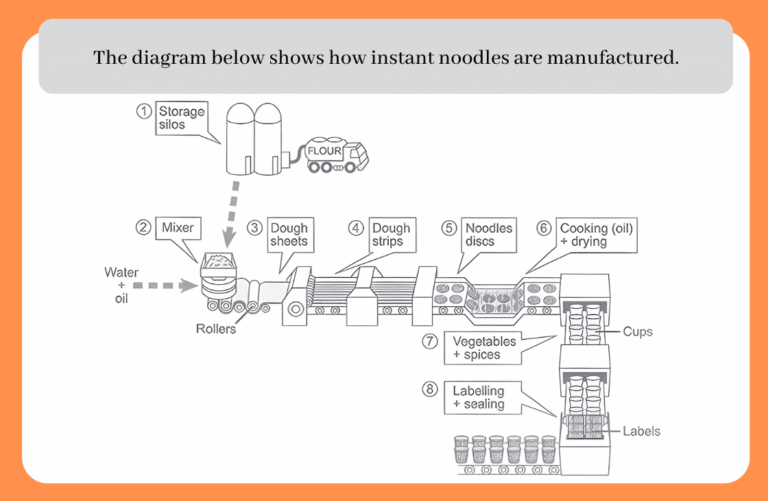
The diagram illustrates the stages involved in the production of instant noodles, tracing the process from flour storage to the final packaging stage.
Following or describing the stages of something from beginning to end.
The diagram illustrates the stages involved in the production of instant noodles, tracing the process from flour storage to the final packaging stage.
A process that moves in a straight order through several steps.
Overall, the procedure follows a linear, multi-stage sequence that begins with flour being taken from storage and mixed with water and oil, and ends with cups being sealed and labelled after they have been filled with noodles.
The final stage of a process results in something.
Overall, the procedure follows a linear, multi-stage sequence that begins with flour being taken from storage and mixed with water and oil, and ends with cups being sealed and labelled after they have been filled with noodles.
During the first steps of the process.
In the initial stages, ingredients are combined and formed into noodle portions.
The stages that come after the earlier ones.
The remaining stages deal with heat treatment and final assembly.
After something else happens; later in the process.
The noodle discs are cooked in oil and subsequently dried as they move along the production line.
Once a particular step in the process is finished.
After this stage has been completed, the dried noodles are placed into individual cups, and vegetables and spices are added before the filled cups are sealed and labelled, completing the manufacturing cycle.
Finishing something so that the whole process is finished.
After this stage has been completed, the dried noodles are placed into individual cups, and vegetables and spices are added before the filled cups are sealed and labelled, completing the manufacturing cycle.
A process that goes through a complete set of stages.
After this stage has been completed, the dried noodles are placed into individual cups, and vegetables and spices are added before the filled cups are sealed and labelled, completing the manufacturing cycle.