
Examiner Comments
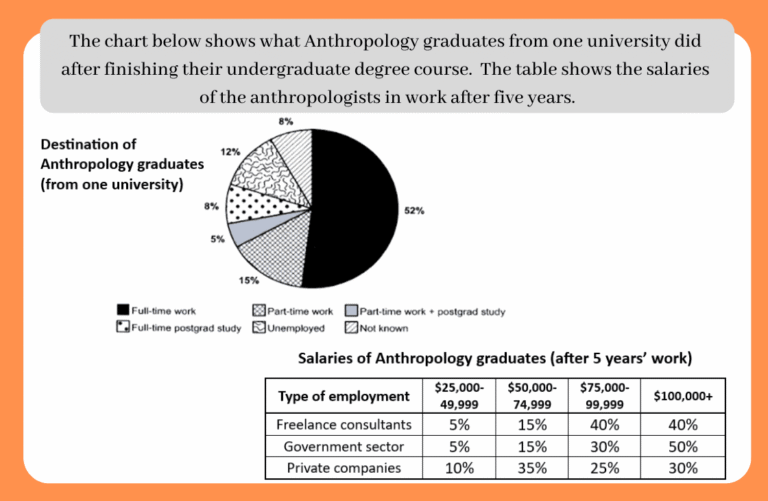
- The response gives a clear and accurate account of both the post-graduation destinations of Anthropology graduates and the salary levels of those in work after five years.
- The opening paragraph successfully restates the task, while the overview is clear and identifies the main features of the data, namely the predominance of employment outcomes and notable differences in earnings between sectors.
- All key categories in the pie chart are addressed, and the most significant salary patterns in the table are selected and reported.
- The description remains closely tied to the information presented, with no over-interpretation or assumptions beyond the data provided.
- The report follows a logical and easy-to-read structure, moving from a general overview to detailed discussion of each visual.
- Graduate destinations and salary outcomes are handled in separate paragraphs, helping to maintain clarity and focus.
- Linking expressions such as overall, in terms of, and by contrast are used effectively to guide the reader through comparisons.
- Paragraphing is clear and consistent, resulting in a smooth progression of ideas.
- The candidate demonstrates good control of vocabulary related to employment and income, using terms such as full-time roles, employment sector, lucrative, and mid-range salaries appropriately.
- Repetition is limited through careful variation in wording, particularly when referring to graduates, work patterns, and pay levels.
- The tone is formal and neutral throughout.
- A range of sentence structures is used confidently, including complex and compound sentences that support clear data reporting.
- Grammar is handled accurately, with appropriate tense choice and consistent use of comparative forms.
- The writing is error-free, allowing the information to be communicated clearly and effectively.
Useful Vocabulary
Started working in a job.
Original sentence: Overall, the majority of graduates entered employment, most commonly in full-time roles.
Usually connected to or linked with something.
After five years, income levels differed noticeably by employment sector, with government and freelance positions generally associated with higher earnings than private-sector jobs.
Successfully obtained something.
In terms of initial destinations, just over half of graduates (52%) secured full-time employment.
Did two things together at the same time.
A further 15% worked part time, while a small proportion (5%) combined part-time work with postgraduate study.
The same proportion or percentage.
Equal shares of graduates either continued with full-time postgraduate education or had outcomes that were unknown, at 8% each.
Final results or end situations.
Equal shares of graduates either continued with full-time postgraduate education or had outcomes that were unknown, at 8% each.
Show clearly.
The salary data reveal clear contrasts across sectors.
Producing a lot of money.
Government employment was the most lucrative overall, with half of anthropologists earning $100,000 or more and a further 30% receiving salaries between $75,000 and $99,999.
Levels or ranges of earnings.
Freelance consultants showed a similar pattern, with 40% earning salaries in each of two highest salary bands.
Earnings in the middle level, not low and not high.
By contrast, those working for private companies were more likely to earn mid-range salaries, with the largest proportion (35%) earning between $50,000 and $74,999.